Description
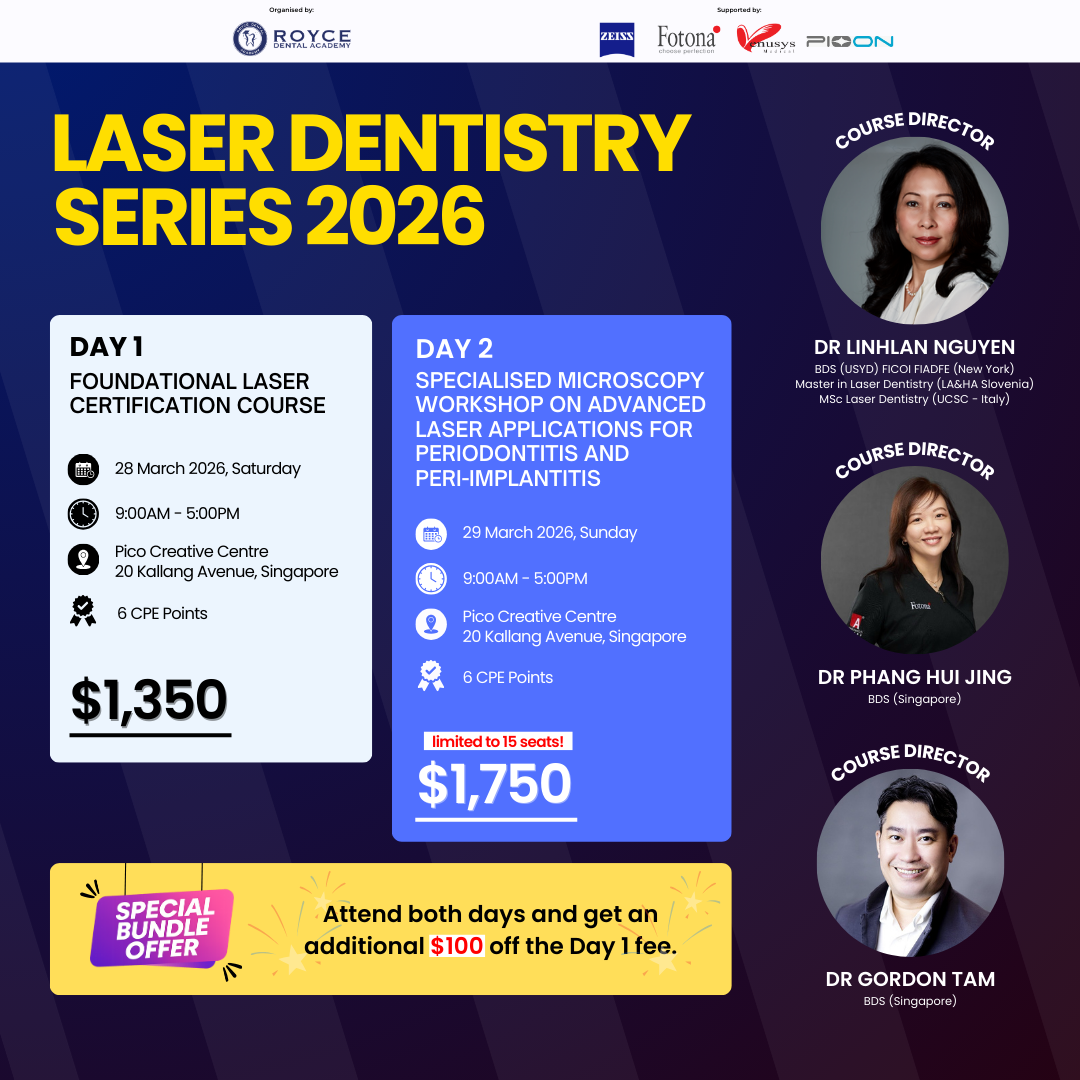
Day 1 Course Overview
Hands-on workshop that provides attendees with essential understanding of laser physics, laser‐tissue interactions, and characteristics of various laser wavelengths utilised in dentistry for hard and soft tissue treatment, important laser safety knowledge and laser regulation in Singapore. General discussion and comparison of various laser dental applications from basic to advanced treatments using diodes and hard tissue laser will be conducted before hands-on session.
The hands-on session will allow dentists to experience how different wavelengths interact on pig jaws. The wavelengths available for this exercise are 450 nm, 650 nm, 810 nm, 980 nm, Er:YAG 2940 nm, Nd:YAG 1064 nm. Please bring some disinfected extracted teeth for the cavity preparation exercise.
The course aims at providing dentists who are new to lasers a good understanding of the capabilities and limitations of common laser wavelengths in dentistry. The knowledge will assist your decision on the right choice of laser purchase for your practice. For existing diodes and hard tissue laser users, this presentation may help you to discover more treatment potentials that you have not attempted, essentially making an impact on your career path and expanding your business horizons.
*Certification will be provided at the end of the course, signed by Dr Linhlan Nguyen, a Certified Laser and Health Academy International Expert Lecturer.
Day 2 Course Overview
The TwinLight® protocol represents a state-of-the-art, minimally invasive laser-assisted approach for the management of periodontitis and peri-implantitis. It synergistically combines two complementary wavelengths—Nd:YAG and Er:YAG—to achieve comprehensive tissue decontamination, biofilm removal, and biostimulation.
The Nd:YAG laser penetrates deeply into the periodontal pocket to selectively remove diseased epithelium, reduce bacterial load, and promote coagulation and biorepair. The Er:YAG laser then precisely removes microbial biofilm and calculus from root or implant surfaces with minimal thermal effect, optimizing the surface for reattachment and regeneration.
A key advancement within this protocol is the integration of AutoSWEEPS photoacoustic irrigation. Unlike direct laser ablation, this Er:YAG-based modality generates cavitation bubbles in the irrigating fluid. The implosion of these bubbles produces shockwaves and rapid fluid motion, dislodging and disrupting biofilm even in areas beyond the laser’s line of sight. This enables three-dimensional decontamination of deep pockets, furcations, and implant threads—offering an unparalleled level of non-contact cleansing and minimally invasive healing.
Further enhancing this approach is the integration of Zeiss dental microscopy, which elevates precision and clinical insight in laser dentistry. Through advanced magnification and coaxial illumination, the microscope allows clinicians to visualize microanatomy, calculus deposits, tissue texture, and laser impact zones with exceptional clarity. This enhanced visualization not only refines the accuracy of periodontal and peri-implant procedures, but also deepens understanding of biofilm behavior and tissue response—strengthening the scientific foundation of minimally invasive care.
Together, the TwinLight® and AutoSWEEPS technologies, when paired with Zeiss microscopy, represent a new level of precision, predictability, and tissue preservation in modern laser dentistry.
Attending this workshop is essential for clinicians seeking to master advanced, microscope-assisted laser protocols. Participants will gain hands-on experience with the TwinLight® sequence, harness AutoSWEEPS photoacoustic cavitation, and appreciate how microscopic visualization transforms diagnosis, technique, and treatment outcomes in both periodontal and peri-implant therapy.